


Why February planning is the difference between a stable patio and shifting stone
If your patio has cracked, settled, or started to “move” after a few Castle Rock winters, the root issue is often water management—not the surface material. Freeze–thaw damage accelerates when water sits on top of hardscape surfaces or becomes trapped in the base and surrounding soils. The good news: you can prevent most of it by planning drainage and base prep before spring construction begins, when conditions are ideal for excavation, compaction, and proper grading.
Rocky Mountain Precision Services helps Castle Rock homeowners design and build outdoor spaces that look sharp and hold up for years—especially in a climate where snowmelt, spring runoff, and freeze–thaw cycles are tough on patios, steps, and walkways.
What freeze–thaw is really doing to your patio (and why drainage is the “multiplier”)
Freeze–thaw problems don’t happen just because it gets cold. They happen because water gets into places it shouldn’t, then expands when it freezes. Over time, that expansion and contraction can:
That’s why drainage planning is your highest-ROI step. Even a premium surface can fail if water is directed toward it or trapped beneath it. Guidance from building-science sources consistently emphasizes grading away from structures and controlling stormwater to prevent saturation.
Castle Rock context: why drainage details matter more here
Along the Front Range, winter often cycles above and below freezing—meaning snow melts, runs, refreezes, and repeats. When that meltwater can’t exit quickly, it heads into the weakest path: joints, cracks, edges, and the base. Many local hardscape failures are less about “bad pavers” and more about:
Step-by-step: winter drainage planning checklist (before you rebuild in spring)
1) Map how water moves during snowmelt
Walk your property during (or right after) a thaw. Note where water pools, where it cuts channels through mulch/rock, and where it runs toward hardscape edges. Pooling water is repeatedly identified as a key contributor to freeze–thaw damage.
2) Confirm the slope away from the house (and away from the patio)
A reliable baseline: grade should slope away from the foundation (commonly expressed as about 0.5 inch per foot for 10 feet, when feasible). If space is tight, swales or drains are recommended to carry water away.
3) Fix roof runoff first: gutters + downspout discharge
Downspouts that dump next to a patio or walk are like a pressure washer aimed at your base. Best practice is to carry that water away to a safe discharge location using extensions or piping, with the discharge well away from the foundation.
4) Choose the right drainage “tool” for your yard
Most properties need a mix of these, not just one:
5) Build the patio base like a drainage system (because it is one)
A durable hardscape isn’t “pavers on sand.” It’s a compacted, free-draining base that resists movement and sheds water. Many best-practice guides emphasize: proper slope, adequate base depth, and compaction in lifts, sometimes with geotextile stabilization depending on soil and conditions.
Common failure patterns we see after winter (and what they usually mean)
Did you know? Quick winter facts that help you plan smarter
Local angle: planning for Castle Rock lots, slopes, and spring runoff
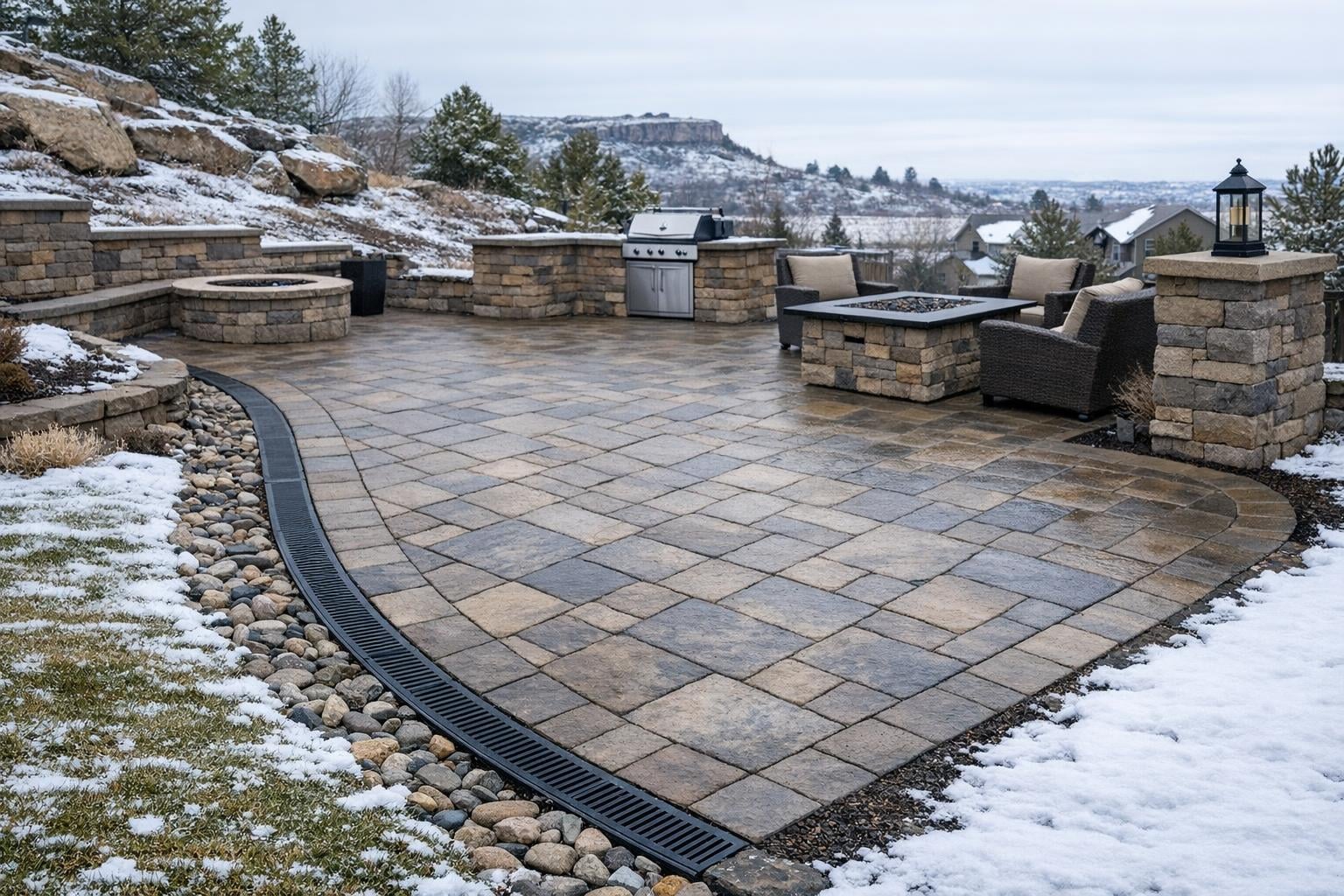
Castle Rock homes often have grade changes that are great for views—but tricky for drainage. A patio at the base of a slope can become the “collection point” for meltwater unless you intentionally intercept and redirect flow upslope. If your yard funnels water toward the house or hardscape:
Ready to plan it once—and stop rebuilding?
If you’re seeing cracked patios, shifting stone, or recurring ice sheets after snowmelt, a site-specific drainage and base plan is the smartest first step. Rocky Mountain Precision Services can evaluate water flow, slope, and base conditions and recommend a build approach designed for Castle Rock’s freeze–thaw cycles.
FAQ: winter drainage planning for patios and hardscapes
How much slope should a patio have?
Many hardscape best practices target about a 2% slope (roughly 1/4″ per foot) to move water off the surface and away from structures, while still feeling comfortable underfoot. Foundation-adjacent grading guidance also emphasizes sloping away from the home and using swales/drains when setbacks limit grading.
Why do pavers shift more than concrete in winter?
Pavers can shift when the base becomes uneven from moisture, freezing, or poor compaction. The upside is that pavers are repairable in sections—but only if the underlying base and drainage are corrected. Joint stabilization (like polymeric sand) and edge restraints can also help reduce movement.
Should I extend my downspouts if my patio is icing over?
Often, yes. Roof runoff is concentrated and can overwhelm soil infiltration during winter thaws. Best practice is to direct downspout discharge away from the foundation and to an approved discharge area using extensions or piping.
Can I fix the drainage without tearing out my patio?
Sometimes. Regrading adjacent soil, adding a swale, or correcting downspout discharge can reduce water reaching the patio. But if the base is already saturated/settled, a partial rebuild may be the only durable option.
What’s the single biggest “don’t” before spring construction?
Don’t finalize the patio shape and elevation before confirming where the water will go. Drainage should drive layout—especially in freeze–thaw climates where trapped water is the fastest path to heaving and cracking.