


- A practical guide for homeowners who want stability first—then curb appeal
- Why retaining walls fail in Castle Rock (and how to prevent it)
- Retaining wall materials commonly used in Colorado (pros, cons, best uses)
- Step-by-step
- Quick “Did you know?” facts for Colorado retaining walls
- Colorado retaining wall material comparison (quick table)
- Local angle
- Ready to stop erosion and stabilize your slope?
- FAQ
- Glossary (helpful terms)
A practical guide for homeowners who want stability first—then curb appeal
When snow melts and spring moisture ramps up in Castle Rock, small yard problems can turn into washouts, slumping slopes, and cracked edging fast. A retaining wall can be the right fix—but only if the material, drainage, and backfill are matched to Colorado’s soils and freeze/thaw cycles. This retaining wall material comparison for Colorado breaks down the most common options, where each shines, and what to prioritize so your wall protects your home and landscape for the long haul.
Why retaining walls fail in Castle Rock (and how to prevent it)
Most retaining wall failures aren’t caused by “bad blocks” or “bad stone.” They happen when water and soil movement aren’t managed. Along Colorado’s Front Range, expansive (swelling) clay is a common issue—clay can expand significantly when wet and shrink when dry, creating repeated seasonal movement and pressure on structures.
Retaining wall materials commonly used in Colorado (pros, cons, best uses)
1) Segmental Concrete Block (SRW)
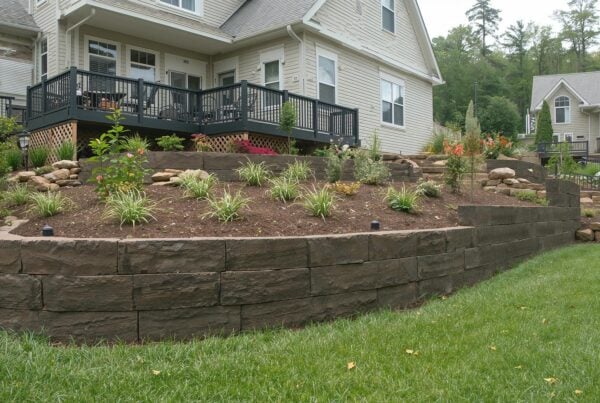
Segmental retaining wall blocks are one of the most popular choices for Castle Rock homes because they’re modular, clean-looking, and can be engineered for taller walls using geogrid reinforcement.
2) Natural Stone (Dry-Stack or Mortared)
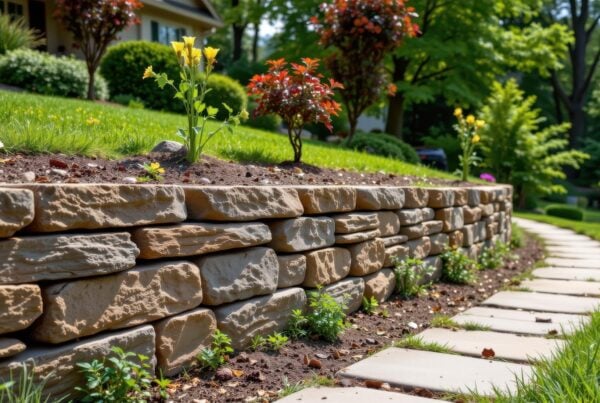
Natural stone is hard to beat visually. A well-built stone wall can also perform very well, especially for shorter, properly drained applications.
3) Poured Concrete / Concrete Stem Wall
Poured concrete walls are strong and can be a great solution where space is tight or loads are high. They’re often used when a clean, modern look is desired or when a structural design calls for it.
4) Boulder / Rockery Walls
Rockery walls use large boulders to hold back soil and create a natural Colorado look. When placed correctly with proper base prep and drainage, they can be an effective erosion-control and slope-management option.
5) Timber (Pressure-Treated) — limited use in Colorado
Timber walls can be budget-friendly upfront, but they’re typically not the first choice for long-term performance in freeze/thaw climates with irrigation and spring runoff.
Step-by-step: how to choose the right wall system for your Castle Rock property
Step 1: Identify the problem (erosion, slope, or usable space)
If soil is washing out after snowmelt, you may need a combination of grading + drainage + a wall (not just a wall). If the slope is failing (slumping, cracking, leaning fences), the wall design may need reinforcement and engineered backfill.
Step 2: Treat water as the main “load”
Hydrostatic pressure (water trapped behind the wall) is one of the most common reasons walls push out or lean. Best practices for segmental retaining walls emphasize water management—drainage, aggregate, and drain pipe are there to move water away from the wall system.
Step 3: Don’t build a “clay wall” (use the right backfill)
In Colorado, expansive clay is a known risk. Using heavy clay as backfill can increase water retention and movement. Many segmental wall best-practice specs recommend avoiding expansive clays and using more granular structural fill, with additional drainage measures when fine soils must be used.
Step 4: Decide if geogrid reinforcement is needed
Taller walls, steeper slopes, poor soils, and tight spaces often require reinforcement (commonly geogrid) so the wall and soil act together as a single stable mass. Common field guidance sets geogrid lengths as a percentage of wall height, with minimums and spacing limits based on soil conditions.
Step 5: Match the material to the look you want (after performance)
Once the base, drainage, and reinforcement approach is clear, the “face” material becomes easier: segmental block for clean lines, natural stone for a high-end organic look, boulders for a rugged Colorado aesthetic, or poured concrete for modern simplicity.
Quick “Did you know?” facts for Colorado retaining walls
Colorado retaining wall material comparison (quick table)
| Material | Best Use | Strength & Height Potential | Drainage Sensitivity | Visual Style |
|---|---|---|---|---|
| Segmental concrete block (SRW) | Terracing, engineered walls, consistent look | High (especially with geogrid) | Very high (must be correct) | Clean, modern, versatile |
| Natural stone | Shorter decorative/structural walls | Medium (depends on build method) | High (needs free-draining backfill) | Premium, natural |
| Poured concrete | Tight spaces, higher loads, sleek finishes | High (when engineered) | Very high (waterproofing + drains) | Modern, smooth or textured |
| Boulder / rockery | Natural slopes, thicker footprint areas | Medium (depends on placement & base) | High (needs drainage behind/within) | Rustic, Colorado-native |
| Timber | Short, budget-focused, limited-lifespan needs | Low to medium | High (rot risk with moisture) | Traditional |
Local angle: Castle Rock terrain and spring moisture—what to prioritize
Castle Rock properties often combine sloped lots, clay-heavy soils, and seasonal moisture swings. That mix can expose weak spots quickly: downspouts dumping near a slope, shallow swales that overflow, or irrigation that keeps one zone saturated.
Priorities that protect your yard (and your foundation)
Ready to stop erosion and stabilize your slope?
Rocky Mountain Precision Services helps Castle Rock homeowners choose the right retaining wall system for their terrain—balancing drainage, durability, and a finished look that fits the home.
FAQ: Retaining walls in Castle Rock, CO
What’s the most durable retaining wall material in Colorado?
Durability is more about the system than the face material. Segmental concrete block and poured concrete can both be very durable, but only when base prep, drainage, and backfill are correct—especially with freeze/thaw and clay movement.
Do I need drainage behind a retaining wall?
In most cases, yes. Water buildup behind a wall increases pressure and is a leading cause of leaning and failure. Best-practice guidance for segmental walls emphasizes water management as a critical element of performance.
Can I use the clay soil from my yard as backfill?
Often, clay-heavy soils are a poor choice behind retaining walls because they hold water and can expand/shrink with moisture changes. Many wall specifications recommend avoiding expansive clays and using granular structural fill, with added drainage measures when fine soils must be used.
When is geogrid reinforcement recommended?
Geogrid is commonly used for taller walls, steeper slopes, weaker soils, or when a wall must support extra loads. Best-practice references include minimum length and spacing guidance tied to wall height and soil type.
How do I know if my slope problem is urgent?
Warning signs include fresh soil cracks near the top of a slope, bulging soil at the bottom, leaning fences, exposed roots, and new rills or channels after runoff events. If you’re seeing movement, addressing drainage and stabilization early is usually less disruptive than waiting for a larger failure.