


A prevention-first guide for homeowners planning spring hardscape work
Winter in Castle Rock doesn’t just “wear down” patios and walkways—it actively moves them. When moisture gets into the soil or base under a hardscape, freezing temperatures can expand that moisture, lift sections (heave), and then let them drop unevenly during thaw. The result is familiar: cracked concrete, shifted pavers, lippage (uneven edges), and water that suddenly drains toward the house instead of away.
If you’ve had hardscape problems after winter, rebuilding is usually less about choosing a prettier surface and more about getting the hidden layers right: base thickness, compaction, drainage, and edge restraint. This guide breaks down the “why” and the “how” with Castle Rock’s freeze–thaw reality in mind.
What freeze–thaw actually does to hardscapes
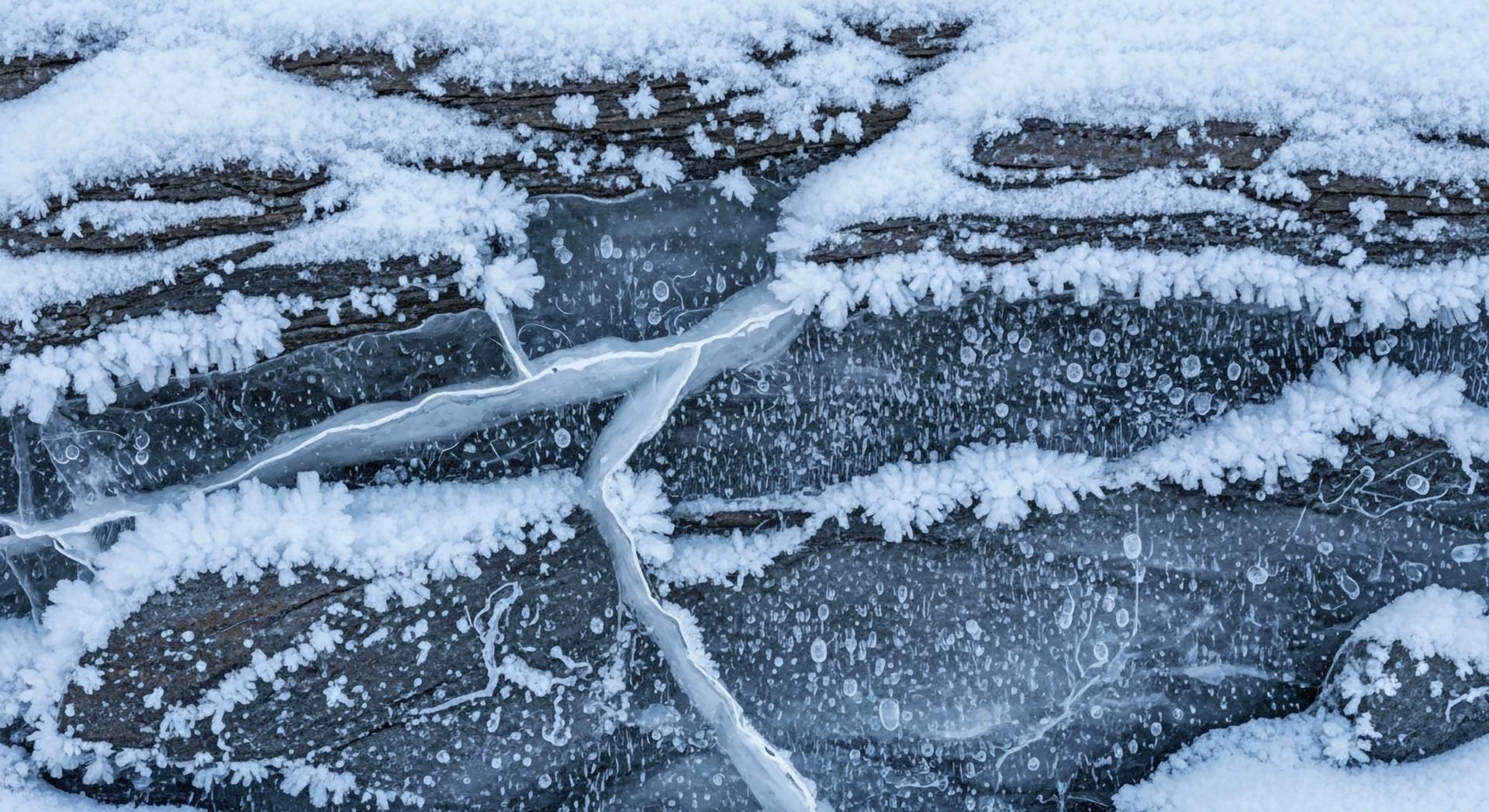
Freeze–thaw damage is rarely caused by “cold” alone. It’s a moisture management problem:
The chain reaction
1) Water gets in (from snowmelt, downspouts, irrigation leaks, or poor grading).
2) It freezes and expands, pushing soil or poorly compacted base upward.
3) It thaws and settles—not always evenly—creating voids, tilt, and cracks.
4) It repeats all season, worsening small defects into structural problems.
In other words: if water can’t get out quickly, the hardscape gets “jacked” up and down until it fails.
The 5 most common failure points we see after winter
1) Base that’s too thin (or the wrong aggregate)
For pedestrian patios and walkways, industry guidance commonly starts around 4–6 inches of compacted aggregate base depending on soils and climate, with thicker builds needed where soils stay wet, are weak, or see frequent freeze–thaw.
2) Poor compaction (or compaction in lifts that are too thick)
A base can look “flat” and still be under-compacted. Compaction should be done in lifts (often about 4–6 inches per lift, depending on equipment) so the entire depth achieves density—this reduces seasonal movement.
3) Water directed toward the hardscape (especially from downspouts)
If roof runoff or snowmelt consistently saturates the subgrade at the edge of a patio, you’ll see settlement and heave that starts at that edge and creeps inward.
4) Incorrect slope (flat patios are rarely “neutral”)
A commonly recommended minimum slope for drainage is about 2% (roughly 1/4″ per foot) away from structures so water doesn’t linger and infiltrate.
5) Missing/weak edge restraint (pavers slowly “walk” apart)
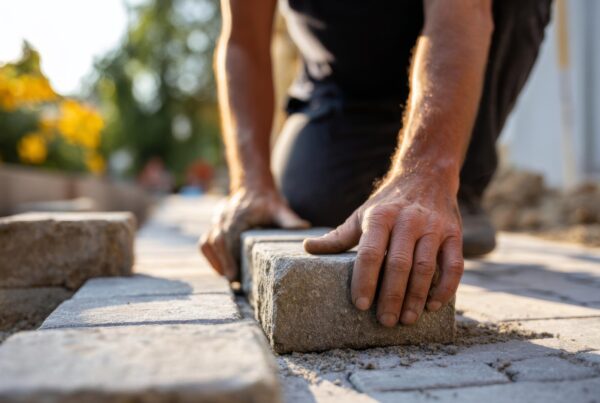
Without solid edge restraint, pavers can creep, bedding sand migrates, joints open, and water infiltrates more easily—accelerating freeze–thaw movement.
Pavers vs. concrete in a freeze–thaw climate: what’s different?
Both systems can perform well in Castle Rock—if installed correctly—but they fail differently:
| Category | Paver Patio | Concrete Patio |
|---|---|---|
| Movement tolerance | Handles minor movement better; individual units can be reset | Movement often shows as cracks; repairs may be more visible |
| Best defense | Correct base thickness, compaction, edge restraint, and joint stabilization | Proper subbase, reinforcement strategy, control joints, and drainage |
| Common winter symptom | Lippage, low spots, pooled meltwater | Cracks, scaling/spalling where water sits and freezes |
If your priority is “serviceability,” pavers can be an excellent fit because sections can be lifted and corrected—assuming the base is built for freeze–thaw in the first place.
Did you know? Quick freeze–thaw facts that explain the “mystery” damage
Compacted soils drain differently than you’d expect
Colorado soils with higher clay content or compaction have fewer large pores, so water moves slowly and saturation happens easily—exactly what freeze–thaw needs to create heave.
Slope is a structural decision, not just a comfort detail
Even well-built surfaces suffer when meltwater can’t leave. Many hardscape standards emphasize sloping away from the home to keep water out of the base.
Retaining walls fail from water pressure as much as from weight
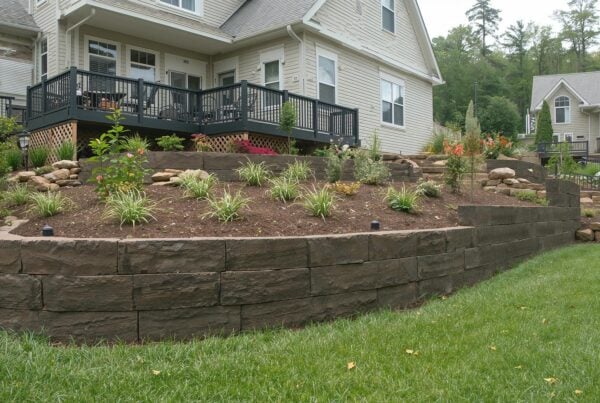
Drainage aggregate and a drainage pipe behind segmental retaining walls are widely emphasized because trapped water can build pressure and contribute to failure—freeze makes it worse.
How to rebuild for durability: a technically sound checklist
These are the details that separate a patio that looks good in May from one that still performs after multiple Castle Rock winters.
Step 1: Diagnose the real water source
Before design choices, identify how water reaches the hardscape: downspouts, swales, irrigation overspray/leaks, or a low spot that collects snowmelt. A simple soil drainage test (dig ~12″ and fill with water) can quickly reveal slow-draining areas that need a plan.
Step 2: Set the correct grade (surface drainage first)
Plan slope intentionally—commonly at least ~2% away from the home—so water sheds off the top instead of infiltrating through joints and edges.
Step 3: Build the base for your soil and exposure—not “minimums”
Many guidelines cite minimums around 4–6 inches of compacted aggregate base for patios/walks, with thickness increasing when soils stay wet/weak or freeze–thaw is frequent. In Castle Rock, the safer design often means planning for more base depth where drainage is imperfect or the subgrade is clay-heavy.
Step 4: Compact in lifts and verify density
Proper lift thickness (often 4–6″) matters because compactors can’t reliably densify deep layers all at once. Uniform compaction helps prevent uneven settling and seasonal movement.
Step 5: Use a separation fabric when soils are silty/clayey
Geotextile separation is commonly recommended over silts/clays to keep fines from migrating into the base (which reduces drainage and causes pumping/settlement).
Step 6: Lock the system together (edges + joints)
Edge restraints prevent lateral creep and loss of bedding sand. Bedding sand is typically kept within recommended thickness ranges so the pavers are supported evenly, not “floating” on soft spots.
Step 7: If you have a retaining wall, treat drainage as structural
Segmental retaining walls rely on free-draining gravel, drainage pipe placement at the base, and managing water above the wall so hydrostatic pressure doesn’t build—especially when freeze amplifies expansion forces.
Castle Rock angle: why February planning saves money in spring
February is the perfect time to plan because you can still see winter symptoms clearly: where snowmelt sits, where ice forms first, and which edges of a patio stay wet. Those observations translate into smarter design details (grading changes, drain locations, downspout extensions, and base depth decisions) before crews and schedules get slammed in spring.
If your patio shifted this winter, don’t assume the surface material is the culprit. Most recurring failures are about water movement through soil and base—especially where compacted or clay-heavy soils drain slowly.
Need a hardscape plan that survives Castle Rock winters?
Rocky Mountain Precision Services helps homeowners rebuild patios, pavers, retaining walls, and concrete with drainage-first prep, correct base construction, and a finish that looks great without repeating last winter’s problems.
Schedule a Hardscape Assessment
Tip: Share photos of problem areas (low spots, cracked sections, leaning edges) to speed up recommendations.
FAQ: Freeze–thaw hardscapes in Colorado
Is freeze–thaw damage inevitable in Castle Rock?
No. Seasonal movement is common, but significant shifting, pooling, and cracking are usually signs of trapped moisture, insufficient base, poor compaction, or incorrect slope. Designing to shed and drain water is the biggest win.
How thick should the base be for a paver patio in freeze–thaw climates?
There isn’t one universal number—soil type, drainage, and exposure matter. Many industry resources cite minimums around 4–6 inches of compacted aggregate for pedestrian patios, with thicker builds needed for weak/wet soils or frequent freeze–thaw. A site-specific evaluation is the safest approach.
What slope should my patio have to prevent water problems?
A common guideline is a minimum of about 2% slope away from structures (roughly 1/4″ per foot), adjusted to site conditions and where the water can safely discharge.
Why did only one corner of my patio sink?
Localized saturation is common—often from a downspout, a low spot that collects meltwater, or a utility trench/backfilled area that was never compacted properly. Fixing the symptom (raising the corner) without fixing the water source typically leads to repeat movement next winter.
Do retaining walls really need drainage behind them?
Yes. Free-draining backfill and a drainage pipe are widely emphasized because water pressure can build behind the wall; freeze–thaw increases risk when trapped water freezes and expands.
Glossary (plain-English)
Freeze–thaw cycle
The repeated freezing and melting of water in soil or materials. It can lift and shift hardscapes when moisture is trapped.
Frost heave
Upward movement of soil or base caused by freezing moisture. Often shows up as raised pavers or tilted slabs.
Subgrade
The native soil beneath your hardscape structure. Its drainage and compaction strongly affect performance.
Aggregate base
A compacted gravel layer that supports the surface, distributes loads, and helps water move away from the hardscape.
Geotextile (separation fabric)
A fabric layer used to separate fine soils from the base aggregate to reduce mixing and maintain drainage.
Edge restraint
A perimeter restraint that keeps pavers from spreading and helps the whole system stay “locked.”