


Stop washouts before they start—especially on Castle Rock slopes
Spring melt and early-season moisture can expose weak points in your landscape fast: rills (small channels cut into soil), slumping along a slope, patio edges that start to sink, or mulch and rock that “migrate” downhill after every storm. In Castle Rock, runoff can be amplified by grade changes, clay-heavy soils that swell when wet, and lots that were shaped quickly during development. The good news: you don’t need a full rebuild to get control. With the right mix of grading, drainage, stabilization, and (when needed) a properly engineered retaining wall, you can protect your yard—and the areas closest to your home—before the next heavy moisture cycle.
Why spring runoff is hard on Castle Rock landscapes
Runoff problems usually come from two things happening at the same time: water concentrates (it finds a path and builds speed) and soil can’t resist it (it detaches, shifts, or saturates).
- Clay-heavy soils: Much of Colorado’s Front Range deals with expansive (swelling) clays that change volume with moisture. That movement can stress hardscape edges and contribute to cracking or settlement if water management is inconsistent.
- Steeper lots and cut/fill slopes: When a yard has a sharp grade (or an older “fill” area), water can quickly carve channels and undercut edges.
- Roof, driveway, and neighbor runoff: Downspouts and pavement collect water and discharge it in one place—often the same place that starts washing out first.
- Immature landscaping: Newer neighborhoods often lack dense roots and canopy cover, so soil is exposed longer and erodes faster.
A practical “runoff first” game plan (what to fix in the right order)
1) Identify where water is coming from and where it’s concentrating
Walk your property during a melt or after a moderate rain. Look for: muddy streaks, gravel piles at the bottom of a slope, water flowing along a fence line, “bathtub rings” of sediment, and soft spots that stay wet. Pay extra attention to downspout outlets, driveway edges, and the side yards where grades tighten.
2) Improve grading and surface flow paths before adding “bigger” structures
Many washouts can be reduced by reshaping the top few inches of soil to create a controlled path: a broad, shallow swale; a gentle pitch away from hardscape edges; or a small berm that prevents water from cutting across a slope. The goal is to keep flow wide and slow so it doesn’t gain erosive force.
Pro tip: If water is pooling or running toward the home, treat that as a priority. Building codes and best-practice guidance consistently emphasize directing surface water away from structures to reduce foundation and support erosion risks.
3) Add drainage where grading alone can’t handle the volume
If runoff is unavoidable (tight side yards, steep backyards, or lots with uphill neighbors), drainage can move water to a safe discharge point.
- Downspout extensions / solid-line piping: Carry roof water to a stable outlet so it doesn’t trench the yard near the foundation.
- Channel drains: Useful at patio edges, garage approaches, or narrow side yards to intercept sheet flow.
- French drains (with the right expectations): Best for subsurface seepage and persistently wet zones—not for handling heavy surface torrents by themselves.
- Dry creek beds / rock swales: A landscape-friendly way to guide water while protecting soil with stone and proper underlayment.
4) Stabilize soil (and only then decide if you need a retaining wall)
If the slope itself is failing—slumping, cracking, or shedding topsoil—stabilization matters as much as drainage. Often the best results come from combining root reinforcement (planting), armoring (rock, matting), and structural support (walls/terracing) where grade changes are too abrupt.
Retaining wall options: clear comparisons for Castle Rock homeowners
| Material / System | Best for | Pros | Watch-outs in spring runoff |
|---|---|---|---|
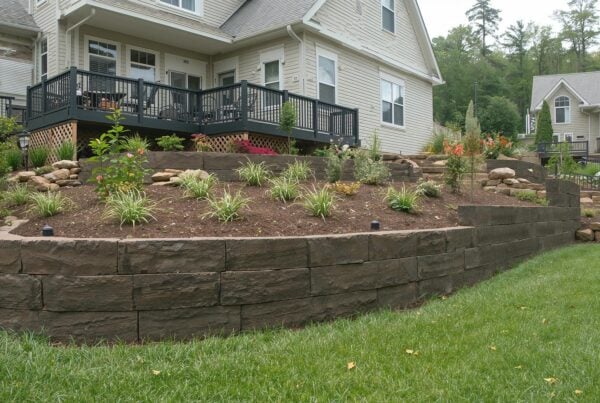
| Segmental block (SRW) | Terracing slopes, clean modern look, medium-height walls | Versatile; attractive; can be engineered; integrates drainage stone | Needs correct base prep and drainage behind wall; poor compaction leads to bulging |
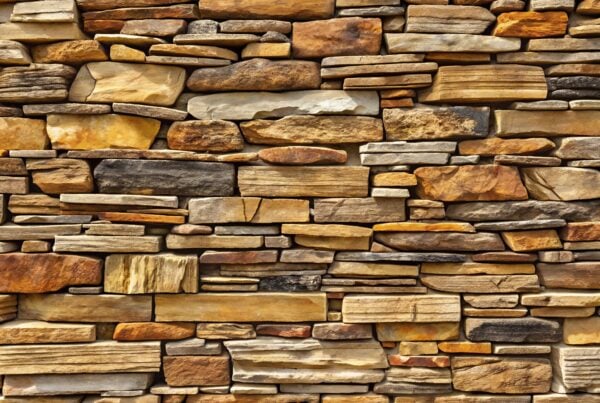
| Natural stone (dry-stack or mortared veneer) | High curb appeal, garden walls, blending with Colorado landscapes | Premium look; can be very durable when built right | Drainage detailing matters; “pretty rock” without proper structure can shift after saturation |
| Poured concrete | Clean lines, tight spaces, high-load areas | Strong; long life; can be formed to fit awkward yards | If water gets trapped behind it, hydrostatic pressure becomes the enemy—weep/drain solutions are non-negotiable |
| Boulder / riprap | Armoring channels and slope toes; naturalized drainage paths | Excellent erosion resistance; looks natural; dissipates flow energy | Needs proper fabric/base to prevent undermining; stone sizing must match expected flow |
What makes a retaining wall “runoff-ready”
- Drainage behind the wall: A wall should not act like a dam. Backfill and drain details relieve water pressure.
- Compacted base and backfill: Many wall failures start as settling that opens gaps and invites more water.
- Proper outlet location: It’s not enough to “collect” water; it needs a stable place to go.
- Soil-aware approach: With expansive soils in Colorado, consistent water management around structures and hardscapes matters.
Erosion control that works (without making your yard look “engineered”)
Surface protection
- Mulch and wood chips (in the right places): Great for slowing sheet flow in planting beds; not ideal in known “runoff chutes.”
- Gravel + stabilizing grid: Helps reduce migration on mild slopes and high-traffic routes.
- Erosion control blankets / matting: Useful on newly graded slopes while plants establish roots.
Vegetation that stabilizes
Plants are not just decorative—roots bind soil and the canopy reduces the impact of heavy drops on bare ground. The key is choosing plants suited to Castle Rock’s sun, wind, and irrigation realities, then pairing them with irrigation that keeps moisture consistent (not flooded one week and bone-dry the next).
Irrigation adjustments (often the hidden cause)
Overwatering can mimic “spring runoff problems” even in dry weather—especially in newer neighborhoods. If you’re seeing algae on sidewalks, constant wet spots, or water flowing during scheduled runs, an audit can prevent erosion and protect hardscapes.
Quick win: Make sure downspouts, irrigation heads, and drip lines are not saturating the same area near foundations or wall bases day after day.
Local angle: what Castle Rock homeowners should watch for
- Side-yard “runoff alleys”: Narrow corridors between homes concentrate flow—channel drains, rock swales, or regrading often help more than adding more mulch.
- Patio edges settling: Often linked to water moving under/around base materials. Fixing the water path protects the investment.
- HOA and neighborhood impacts: If water is coming from uphill lots, solutions may involve coordination (and choosing discharge points that don’t create downstream problems).
- Permitting and standards: Castle Rock has stormwater and erosion-control expectations for disturbed soil; responsible projects plan for sediment control during work.
Ready for a plan that prevents spring runoff damage?
Rocky Mountain Precision Services helps Castle Rock homeowners stabilize slopes, install retaining walls built for drainage, and correct grading and runoff patterns that cause washouts. If you can point to where the water starts and where the damage shows up, we can usually map a clear path to a long-lasting fix.
FAQ: Spring runoff, retaining walls, and erosion control
Do I need a retaining wall, or can drainage alone fix it?
If the problem is mostly water concentrating and cutting channels, drainage + regrading often solves it. If the ground is physically moving (slumping, cracking, losing elevation), a wall/terracing or structural stabilization may be needed. Many properties benefit from both: manage water first, then support the grade.
Why does my yard wash out even when it doesn’t rain that hard?
Concentrated flow is the culprit. Roof water, driveway runoff, and even irrigation can combine into a steady stream that acts like a hose on soil. Once a small channel forms, it pulls more water into the same path and grows faster each event.
What are the warning signs a slope is failing (not just eroding)?
Look for crescent-shaped cracks, sections that look “tilted,” soil pulling away from a patio edge, or fence posts starting to lean downhill. Those typically indicate soil mass movement, not just topsoil loss.
Can I just add more rock or mulch to stop erosion?
Sometimes—if it’s light sheet flow. But if water is channeling, rock and mulch can get displaced and make cleanup worse. In those cases, you’ll get better results by reshaping the flow path (swale/berm/grade correction) and providing a stable outlet.
Will irrigation changes really make a difference in spring runoff damage prevention?
Yes—especially on slopes and near hardscape edges. Overwatering can saturate soil and reduce its strength, making it easier for runoff to carve channels or for a slope to slump. A smart schedule and properly aimed heads often reduce erosion noticeably.